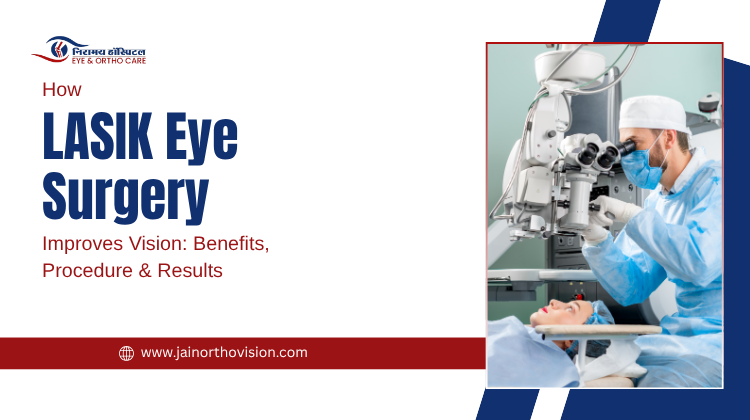
LASIK eye surgery improves vision by reshaping the cornea with a precise laser, allowing light to focus correctly on the retina. This corrects common refractive errors like nearsightedness, farsightedness, and astigmatism, often eliminating the need for glasses or contact lenses entirely.
At Niramaya Hospital, we perform LASIK for patients who are tired of daily lens care and want a lasting solution to blurry vision.
What Is LASIK Eye Surgery?
LASIK stands for laser-assisted in situ keratomileusis, a refractive surgery that has been performed since the late 1980s and remains the most widely used vision correction procedure worldwide. During the procedure, a surgeon creates a thin flap in the cornea, then uses a laser to reshape the tissue underneath before repositioning the flap.
This reshaping changes how light bends as it enters the eye, correcting the refractive error that caused blurry vision in the first place. The entire procedure typically takes only 15 to 30 minutes for both eyes combined.
How Does LASIK Eye Surgery Improve Vision?
LASIK eye surgery improves vision by directly correcting the shape of the cornea, which is the root cause of most common vision problems. In nearsightedness, the cornea is too steeply curved, and in farsightedness, it is too flat, while astigmatism involves an irregular corneal shape altogether.
The excimer laser used during LASIK removes microscopic amounts of corneal tissue with extreme precision, flattening, steepening, or smoothing the surface as needed. Once the cornea is reshaped correctly, light entering the eye focuses precisely on the retina, producing clear, sharp vision without the correction glasses or contacts previously provided.
Key Benefits of LASIK Eye Surgery
Patients considering LASIK eye surgery often want to understand exactly what they stand to gain beyond simply not wearing glasses. The benefits extend well beyond convenience.
- High success rates: The vast majority of patients achieve 20/20 vision or better after the procedure
- Fast visual recovery: Most patients notice clearer vision within 24 to 48 hours
- Long-lasting results: The corneal reshaping is permanent, though natural aging can still affect vision later in life
- Reduced dependence on glasses or contacts: Many patients no longer need them at all, or only for specific tasks like night driving
- Quick procedure with minimal downtime: Most people return to normal activities within a few days
- High patient satisfaction: The vast majority of LASIK patients report being satisfied with their results
These benefits explain why LASIK remains the preferred choice among patients who qualify for refractive surgery.
The LASIK Procedure: What to Expect Step by Step
Understanding each stage of the procedure helps ease anxiety for first-time patients. The process generally follows a consistent sequence.
- Pre-surgical evaluation: Corneal thickness, prescription strength, and overall eye health are assessed to confirm candidacy
- Numbing drops applied: The eye is numbed with topical anesthetic drops, so no injections or general anesthesia are needed
- Corneal flap creation: A thin flap is created using a precise laser or specialized blade
- Laser reshaping: An excimer laser reshapes the corneal tissue based on your specific prescription
- Flap repositioning: The flap is placed back in position, where it naturally adheres without stitches
- Short recovery period: Patients typically rest briefly before heading home the same day
The entire experience, from arrival to walking out, usually takes under two hours including preparation time.
Who Is a Good Candidate for LASIK?
Not everyone is automatically eligible for LASIK eye surgery, and a thorough pre-surgical evaluation is essential before scheduling the procedure. Good candidates typically have:
- Stable vision prescription for at least one year
- Adequate corneal thickness to safely support reshaping
- No significant dry eye disease or corneal irregularities
- Age generally between 18 and 45, though exceptions exist
- Realistic expectations about the outcome
- No active eye infections or certain autoimmune conditions
An experienced Eye Doctor in Kota can determine candidacy through corneal mapping and a comprehensive eye examination before recommending the procedure.
What Results Can You Expect After LASIK?
Long-term studies following LASIK patients for years after surgery show consistently strong outcomes. A large share of patients maintain 20/20 vision even a decade after their procedure, with only a small percentage needing a touch-up enhancement over that time.
Most patients notice significantly clearer vision within the first day or two after surgery, though full visual stabilization can take a few months as the eye completes its healing process. Serious complications remain rare, occurring in well under 1 percent of cases, making LASIK one of the most extensively studied elective procedures performed today.
It is worth noting that LASIK does not prevent natural age-related vision changes. Some patients may eventually need reading glasses later in life, not because the surgery failed, but because the eye continues to age naturally after the correction.
LASIK Recovery Timeline
Recovery from LASIK eye surgery is notably faster than many other surgical procedures, which is part of its widespread appeal.
| Recovery Stage | Timeframe | What to Expect |
| First few hours | Same day | Mild grittiness, light sensitivity, blurry vision |
| First 24 to 48 hours | Day 1 to 2 | Noticeable improvement in vision clarity |
| First week | Days 3 to 7 | Return to most normal activities, avoiding eye rubbing |
| First month | Weeks 2 to 4 | Continued improvement, avoiding swimming and contact sports |
| Full stabilization | 3 to 6 months | Vision settles into its final, stable result |
Following post-operative instructions carefully during this window plays a major role in achieving the best possible outcome.
Possible Risks and Side Effects of LASIK
While LASIK eye surgery has an excellent safety record, understanding potential side effects helps set realistic expectations. Most side effects are mild and temporary.
- Temporary dry eyes, which usually improve within a few months
- Glare or halos around lights, particularly at night
- Under-correction or over-correction requiring a touch-up procedure
- Temporary light sensitivity during the initial healing period
- Rare but serious complications, such as infection or flap-related issues
A detailed consultation at a trusted Ophthalmology Clinic in Kota helps identify any personal risk factors before surgery, further reducing the already low chance of complications.
Why Choose Niramaya Hospital for LASIK in Kota
Choosing where to have LASIK eye surgery performed matters just as much as the decision to undergo the procedure itself. Precise pre-surgical screening and skilled laser calibration are what separate excellent outcomes from mediocre ones.
Niramaya Hospital is recognized as the best eye hospital in Kota for LASIK because our team combines advanced diagnostic technology with an honest, thorough candidacy evaluation for every patient.
Our specialists also take the time to explain your specific corneal profile and expected outcome in plain language, so you feel fully informed before committing to surgery. This is the kind of guidance an experienced eye specialist in Kota should offer every patient, not just those who ask detailed questions.
Frequently Asked Questions About LASIK Eye Surgery
1. Is LASIK eye surgery painful?
No. Numbing drops are used throughout the procedure, so most patients feel only mild pressure, not pain. Some temporary grittiness or discomfort is common during the first day of recovery.
2. How long do LASIK results last?
LASIK results are considered permanent, since the surgery physically reshapes the cornea. However, natural age-related vision changes can still occur later in life, unrelated to the surgery itself.
3. Can LASIK correct all vision problems?
LASIK effectively treats nearsightedness, farsightedness, and astigmatism, but it does not correct presbyopia, the age-related loss of near focusing ability that most people experience after their mid-40s.
4. What percentage of people achieve 20/20 vision after LASIK?
A large majority of LASIK patients achieve 20/20 vision or better, with high satisfaction rates reported consistently across long-term studies.
5. How soon can I return to work after LASIK?
Most patients return to work within one to two days, though those with jobs involving significant screen time or dusty environments may benefit from a slightly longer break.
Conclusion
LASIK eye surgery improves vision by precisely reshaping the cornea, offering most patients lasting freedom from glasses and contact lenses with a fast recovery and a strong safety record. While it is not the right choice for everyone, a proper candidacy evaluation makes it possible to know exactly what results to expect before committing to surgery.
If blurry vision and daily lens care have become frustrating, do not keep putting off the conversation. Book a consultation with Niramaya Hospital and let our experienced team evaluate your candidacy for LASIK and walk you through what results you can realistically expect. Call us today or visit our clinic to schedule your LASIK evaluation.