
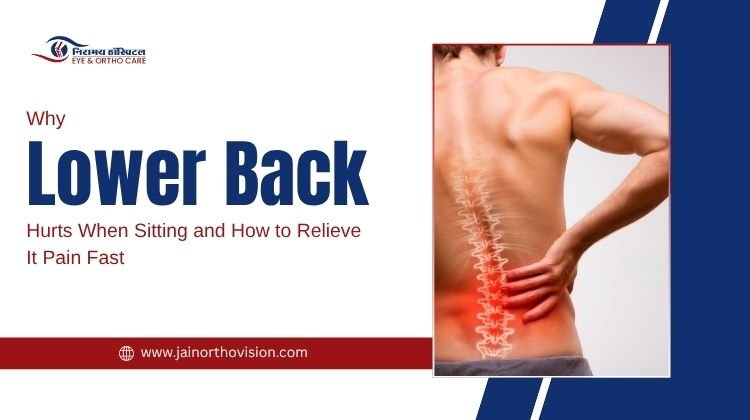
Sitting feels like rest. For your lower back, it is anything but. When you sit, especially with poor posture while sitting, the pressure on your lumbar discs increases significantly compared to standing. The muscles that support your spine relax, your pelvis tilts backward, and your natural lumbar curve flattens. Over time, this repeated mechanical stress leads to pain that builds quietly and then becomes very hard to ignore.
This is exactly the pattern seen by specialists at Jain Ortho, a trusted Back Pain Treatment Clinic in Kota. Patients frequently describe pain that starts as mild stiffness and progresses to sharp discomfort that limits their ability to sit, drive, or concentrate at work.
Quick Fact: Lower back pain is the leading cause of disability worldwide according to the World Health Organization. A significant proportion of this pain is directly linked to prolonged sitting and sedentary lifestyle effects on spinal structures.
What Happens to Your Spine When You Sit for Long Hours
To understand why my lower back hurts when I sit for long hours, it helps to understand what your spine experiences in a seated position.
Your lumbar spine has a natural inward curve called lordosis. This curve distributes body weight evenly across your vertebrae and discs. When you sit, especially on soft or unsupportive chairs, this curve tends to flatten or reverse. The result is uneven loading across the discs, which are the shock-absorbing pads between your vertebrae.
Over time, this uneven loading causes:
- Disc compression that pushes against surrounding nerve roots
- Shortening and tightening of hip flexor muscles
- Weakening of the deep core muscles that stabilize the spine
- Inflammation in the facet joints at the back of the spine
- Gradual development of herniated disc symptoms in severe cases
The longer this pattern continues without intervention, the greater the risk of developing chronic lower back pain that no longer responds to simple rest or basic stretching. This is when patients typically seek out a spine specialist for back pain in Kota for proper clinical evaluation.
Common Causes of Lower Back Pain While Sitting
Understanding the causes of lower back pain while sitting at a desk job helps you take targeted action rather than generic measures. Here are the most clinically significant causes:
1. Poor Posture While Sitting
Slouching forward, rounding the shoulders, and letting the lower back collapse removes support from the lumbar spine. This is the most common and most correctable cause seen by the best orthopedic for back pain in Kota.
2. Herniated or Bulging Discs
When disc material pushes outward and presses on a nearby nerve, sitting becomes acutely painful. Herniated disc symptoms include sharp radiating pain, numbness, or tingling down one or both legs. Sitting increases disc pressure and worsens these symptoms directly.
3. Muscle Strain in the Lower Back
Repetitive micro-stress from sustained sitting without movement leads to muscle strain in lower back tissues. These muscles fatigue, tighten, and develop trigger points that refer pain across the lumbar region.
4. Sedentary Lifestyle Effects
A body that moves too little loses the muscular support that protects spinal structures. Sedentary lifestyle effects include poor blood circulation to discs, reduced core muscle strength, and increased susceptibility to injury from simple everyday movements.
5. Spine Alignment Issues
Conditions like scoliosis, pelvic tilt imbalances, and leg length discrepancies create uneven loading across the spine. Spine alignment issues become particularly noticeable during prolonged sitting because there is no movement to distribute the load.
Sitting Position and Back Pain: Comparison Table
| Sitting Habit | Effect on Lower Back | Risk Level |
| Slouching forward | Flattens lumbar curve, increases disc pressure | High |
| Crossing legs | Creates pelvic tilt and spinal rotation | Moderate |
| Sitting without back support | Overloads lumbar muscles and facet joints | High |
| Leaning to one side | Causes lateral spinal imbalance over time | Moderate |
| Correct upright posture | Maintains natural lordosis and even disc load | Low |
| Using lumbar support cushion | Reduces muscle fatigue and disc compression | Low |
| Taking regular movement breaks | Restores circulation and disc rehydration | Protective |
This table is a practical reference for patients managing sitting back pain and seeking to improve daily habits alongside formal low back pain treatment in Kota.
How to Relieve Lower Back Pain from Sitting Quickly
If you are looking for how to relieve lower back pain from sitting quickly, these evidence-based steps can bring fast and meaningful relief:
Immediate Relief Steps
- Stand up and walk for a few minutes to restore spinal circulation and reduce disc pressure.
- Apply a warm heat pack to the lower back for fifteen to twenty minutes to relax tight muscles.
- Perform a gentle knee-to-chest stretch lying flat on your back. Hold each side for several seconds.
- Try a standing cat-cow movement, gently arching and rounding your lower back to mobilize stiff segments.
Postural Adjustments at Your Desk
- Adjust your chair so your hips are at or slightly above knee level.
- Use a lumbar support cushion or rolled towel behind your lower back.
- Position your screen at eye level to prevent forward head posture, which increases lumbar strain.
- Keep both feet flat on the floor and avoid crossing your legs.
Movement Habits That Protect Your Spine
- Take a short standing break regularly throughout your work period.
- Set a timer to remind yourself to shift position if you tend to stay still for long stretches.
- Walk during phone calls instead of sitting.
- Avoid sitting immediately after meals, as digestion combined with spinal compression increases discomfort.
These steps provide fast relief tips for lower back pain after sitting and form the foundation of any good advanced back pain relief treatment in the Kota program.
Best Exercises for Lower Back Pain Due to Sitting
Regular movement is the most powerful long-term tool against chronic lower back pain. The best exercises for lower back pain due to sitting include movements that restore lumbar mobility, strengthen the core, and release hip flexor tension.
Recommended Exercises
- Child’s Pose: Kneels and reaches arms forward, stretching the entire lumbar region gently.
- Pelvic Tilts: Lying flat, gently flatten and arch the lower back to restore movement in the lumbar joints.
- Glute Bridges: Strengthens the gluteal muscles that support the pelvis and reduce lumbar loading.
- Cat-Cow Stretch: Mobilizes the thoracic and lumbar spine through gentle flexion and extension.
- Hip Flexor Stretch: Kneeling lunge position, gently pushing the hips forward to release tight hip flexors from sitting.
- Bird-Dog: A core stability exercise that builds deep spinal muscle strength without compressing the discs.
These exercises should be performed consistently and ideally guided initially by a physiotherapist at a chronic low back pain treatment in Kota clinic to ensure correct technique.
When to See a Low Back Pain Specialist in Kota
Home care and postural adjustments work well for mild to moderate pain. However, you should consult a low back pain specialist in Kota Rajasthan without delay if you experience:
- Pain that radiates down one or both legs
- Numbness, tingling, or weakness in the legs or feet
- Back pain that wakes you from sleep
- Pain that has not improved after several weeks of self-care
- Difficulty standing straight or walking normally
- Bladder or bowel changes alongside back pain
These symptoms suggest nerve involvement or a structural spinal issue that requires imaging and specialist evaluation. An orthopedic doctor for low back pain in Kota can determine whether non-surgical low back pain treatment in Kota is appropriate or whether further intervention is needed.
Case Study
Priya worked long hours at a desk processing loan files. Over several months she began feeling a dull ache in her lower back that worsened throughout the day and peaked during her evening commute home. She managed with over-the-counter pain relief for a while, assuming it would pass.
When Priya visited Jain Ortho, a detailed spine assessment revealed early spine alignment issues combined with mild disc compression at the lumbar level. She had no fracture or nerve damage. Her pain was the direct result of sustained poor posture while sitting and weakened core muscles.
Her treatment plan included non-surgical low back pain treatment in Kota through structured physiotherapy, postural correction guidance, ergonomic desk adjustments, and targeted exercises. Within a few weeks, her daily pain reduced substantially. She now works full hours without discomfort and has not required any medication since completing her rehabilitation program.
Priya’s case represents thousands of working adults in Kota whose back pain has a clear, correctable cause when identified early by the best doctor for low back pain in Kota.
FAQ’s About Low Back Pain Treatment
Q1. Why does my lower back hurt when I sit for long hours?
Prolonged sitting flattens the lumbar curve, compresses spinal discs, and weakens supporting muscles, all of which cause lower back pain.
Q2. How to relieve lower back pain from sitting quickly?
Stand up, walk briefly, apply heat, and do a gentle knee-to-chest stretch for fast lower back pain relief after sitting.
Q3. What are the best exercises for lower back pain due to sitting?
Child’s pose, pelvic tilts, glute bridges, cat-cow stretches, and bird-dog exercises effectively relieve and prevent sitting-related lower back pain.
Q4. What causes lower back pain while sitting at a desk job?
Poor posture, weak core muscles, sedentary habits, herniated discs, and spine alignment issues are the main causes of desk-related back pain.
Q5. Is lower back pain from sitting a serious condition?
Mild pain from sitting is manageable. Pain with leg numbness, tingling, or weakness requires prompt evaluation by a spine specialist.
Q6. How does poor posture while sitting damage the spine?
Poor posture flattens the lumbar curve, increases disc pressure unevenly, and strains surrounding muscles, gradually causing structural spine problems.
Q7. Can a sedentary lifestyle cause chronic lower back pain?
Yes. Prolonged inactivity weakens core and spinal muscles, reduces disc hydration, and increases vulnerability to chronic lower back pain over time.
Q8. When should I see a doctor for lower back pain from sitting?
See a doctor if pain radiates to your legs, disrupts sleep, causes numbness, or has not improved after several weeks of self-care.
Conclusion
Lower back pain from sitting is not simply a side effect of a busy work life. It is a clinical pattern with clear causes and effective solutions. Recognizing the role of poor posture while sitting, sedentary lifestyle effects, and early herniated disc symptoms gives you the power to act before the condition deepens. Structured care from a qualified low back pain specialist in Kota Rajasthan addresses the root cause, not just the symptom. At Jain Ortho, patients receive expert spine assessment and personalized low back pain treatment in Kota that gets them back to daily life without pain.