
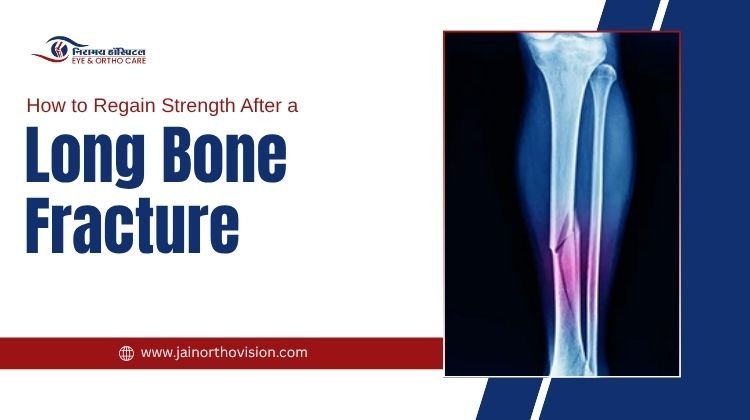
Breaking a long bone, whether the femur, tibia, fibula, humerus, or radius, is one of the most physically demanding injuries to recover from. The bone itself heals. But the muscle loss, joint stiffness after fracture, and reduced confidence in movement that accompany the healing process require deliberate, guided rehabilitation to fully reverse.
Many patients completing long bone fracture treatment in Kota at Jain Ortho are surprised to find that regaining strength and mobility is often harder than surviving the initial injury and surgery. The bone unites. The surrounding tissue takes longer to respond. Without a structured recovery plan, patients risk long-term weakness, altered movement patterns, and a significantly higher chance of re-injury.
Quick Fact: Prolonged immobilization after a long bone fracture leads to significant muscle loss in the affected limb. The muscles surrounding the fracture site can lose a large portion of their strength during the period of immobilization alone. This is why post fracture rehabilitation must begin as early as the treating orthopedic specialist permits.
Understanding What Happens to Your Body After a Long Bone Fracture
To understand how to regain strength after a leg bone fracture fast, it is important to understand what the body experiences during and after immobilization.
When a long bone fractures, the body initiates a healing cascade. New bone tissue forms at the fracture site over several weeks. During this period, the limb is typically immobilized through casting, bracing, or surgical fixation. This immobilization is necessary for bone union but has significant consequences for the surrounding soft tissue.
Here is what happens to the body during fracture immobilization:
- Muscles surrounding the fracture site begin to atrophy within the first few days of immobilization.
- Joint stiffness after fracture develops as the joint capsule, tendons, and ligaments tighten from disuse.
- Circulation in the affected limb reduces, slowing the delivery of nutrients needed for healing.
- The nervous system partially loses its connection to the affected muscles, reducing coordination and reflexive stability.
- Bone density in the affected limb begins to reduce through a process called disuse osteoporosis.
All of these changes need to be actively reversed through a structured bone fracture recovery program. The good news is that the body responds well to progressive rehabilitation when it is started at the right time and progressed correctly.
The Rehabilitation Timeline for Long Bone Fractures
Understanding the rehabilitation timeline for fractures helps patients set realistic expectations and stay committed through each phase of recovery.
| Recovery Phase | Focus | Key Activities |
| Early Phase (Immobilization) | Protect the fracture site | Gentle movement of unaffected joints, circulation exercises |
| Intermediate Phase (Early Weight Bearing) | Restore mobility and begin loading | Range of motion exercises, partial weight bearing, gentle strengthening |
| Active Rehabilitation Phase | Build strength and endurance | Progressive resistance exercises, balance training, functional movement |
| Advanced Phase (Return to Activity) | Full strength and confidence | Sport or work-specific training, full weight bearing, endurance building |
| Maintenance Phase | Sustain gains and prevent re-injury | Home exercise program, regular activity, nutritional support |
This timeline is a general guide. The specific progression for each patient at Jain Ortho is determined by bone healing confirmed through imaging, pain levels, and the individual’s response to each phase of their physical therapy after the fracture program.
Best Exercises After Long Bone Fracture Recovery
The best exercises after long bone fracture recovery are those that progressively challenge the healing limb without overloading the fracture site. Here is a phase-by-phase breakdown:
1. Early Phase Exercises
These begin while the bone is still healing and focus on maintaining circulation and preventing excessive joint stiffness:
- Ankle pumps and circles to maintain circulation in the lower limb
- Gentle quadriceps sets, tightening the thigh muscle without moving the joint
- Heel slides while lying flat, moving the knee through a pain-free range
- Upper body and core exercises to maintain overall fitness during lower limb recovery
2. Intermediate Phase Exercises
As weight bearing progresses under specialist guidance:
- Seated leg raises to begin rebuilding quadriceps strength
- Assisted standing balance exercises with support
- Mobility improvement exercises including gentle knee flexion and extension in a supported position
- Short supported walks progressing gradually in distance
3. Advanced Strengthening Exercises
Once the bone is confirmed healed and full weight bearing is permitted:
- Bodyweight squats progressing to resistance squats as strength returns
- Step-ups using a low step, building height gradually
- Straight leg deadlifts to rebuild posterior chain strength
- Single leg balance exercises to restore proprioception and joint stability
- Resistance band exercises targeting hip abductors, adductors, and glutes
All exercises should be supervised initially by a physiotherapist experienced in post fracture rehabilitation to ensure correct technique and appropriate progression.
Physiotherapy Tips After Femur Fracture Surgery
A femur fracture is one of the most significant long bone injuries due to the size and weight-bearing role of the thighbone. Physiotherapy tips after femur fracture surgery are specific and require particular attention:
- Begin gentle knee mobilization as soon as your surgeon gives clearance, as the knee is highly susceptible to post-fracture stiffness.
- Work on hip strength simultaneously, as femur fractures often create weakness through the entire hip and pelvis region.
- Progress weight bearing gradually and only as directed by your orthopedic team. Premature full loading risks implant failure.
- Use aquatic therapy if available, as water reduces loading while allowing full range movement during early rehabilitation.
- Focus on gait retraining with a physiotherapist to prevent a compensatory limp from becoming a permanent movement habit.
- Track your progress with regular physiotherapy assessments and imaging reviews at your bone fracture treatment near me
The Role of Calcium and Vitamin D in Bone Healing
Rehabilitation is not only about movement. Calcium and vitamin D for bone healing are essential nutritional components that directly influence how quickly and completely the bone rebuilds after a fracture.
Calcium is the primary mineral in bone tissue. During fracture healing, the body requires a reliable supply of calcium to form new bone at the fracture site. Dietary sources include dairy products, leafy green vegetables, fortified foods, and legumes.
Vitamin D is essential for calcium absorption in the gut. Without adequate vitamin D, calcium from food is poorly absorbed regardless of how much is consumed. Sun exposure remains the most natural source, supplemented by fatty fish, eggs, and fortified foods when needed.
Patients receiving treatment for bone fracture in leg in Kota at Jain Ortho receive dietary and supplementation guidance as part of their overall recovery plan. A bone that is well-nourished heals faster, stronger, and with fewer complications.
Home Exercises to Recover Strength After Bone Injury
For patients managing recovery between clinic visits, these home exercises to recover strength after bone injury can be performed safely:
- Seated knee extensions: Sitting on a chair, straighten the knee fully and hold for several seconds. This rebuilds quadriceps strength without loading the fracture site.
- Calf raises: Standing with support, rise onto tiptoes and lower slowly. This rebuilds lower leg strength and improves ankle stability.
- Glute squeezes: Lying flat, tighten the buttocks and hold. This activates the gluteal muscles that support the hip and pelvis during walking.
- Supine heel slides: Lying on your back, slide the heel toward the body bending the knee, then return. This restores knee range of motion gently.
- Standing hip abduction: Standing with support, lift the affected leg out to the side slowly. This rebuilds the hip stabilizers needed for walking.
Consistency with home exercises between physiotherapy sessions significantly accelerates the overall bone fracture recovery timeline.
How Long Does It Take to Rebuild Strength After a Fracture
How long does it take to rebuild strength after a fracture is the question every patient asks. The honest answer is that it depends on several interconnected factors:
- The specific bone fractured and its weight-bearing role in daily movement
- Whether the fracture required surgical fixation or was managed conservatively
- The individual’s age, general health, and nutritional status
- How consistently and correctly the rehabilitation program is followed
- The presence of any complications such as infection, malunion, or nerve involvement
What can be said with confidence is that patients who begin structured post fracture rehabilitation early, follow their program consistently, and receive regular specialist review at a long bone fracture treatment in Kota clinic recover faster and more completely than those who rely on rest alone.
Case Study
Rajesh sustained a femur fracture following a fall at a construction site. He was treated at Jain Ortho where he underwent surgical fixation using an intramedullary nail. The bone was stabilized successfully, but when Rajesh was cleared to begin bearing weight, he found his leg felt entirely foreign. He had no strength in his quadriceps, his knee had become stiff, and he was afraid to put full weight through the limb.
His rehabilitation program at Jain Ortho began with gentle mobility improvement exercises while still partially non-weight-bearing. As bone healing progressed, the program advanced through muscle strengthening after fracture protocols targeting the quadriceps, hamstrings, glutes, and calf muscles. Nutritional guidance on calcium and vitamin D for bone healing was incorporated throughout.
Rajesh returned to supervising at his worksite after completing his full rehabilitation program. He regained complete strength and range of motion in the affected leg. His case demonstrates that structured, progressive rehabilitation following long bone fracture treatment in Kota is what transforms a healed bone back into a fully functional limb.
FAQ’s About Long Bone Fracture Treatment
Q1. How do I regain strength after a leg bone fracture fast?
Begin physiotherapy as soon as your surgeon permits. Follow a progressive exercise plan and maintain proper nutrition for faster strength recovery.
Q2. What are the best exercises after long bone fracture recovery?
Seated leg raises, heel slides, step-ups, glute bridges, and resistance band exercises are among the most effective post-fracture strengthening exercises.
Q3. How long does it take to rebuild strength after a fracture?
Recovery varies by bone and individual. Most patients regain functional strength within several months with consistent, guided physiotherapy and proper nutrition.
Q4. What are the best physiotherapy tips after femur fracture surgery?
Begin knee mobilization early, progress weight bearing gradually, focus on gait retraining, and maintain hip and core strength throughout your rehabilitation program.
Q5. What home exercises help recover strength after a bone injury?
Seated knee extensions, calf raises, glute squeezes, heel slides, and standing hip abduction are safe and effective home recovery exercises after bone fracture.
Q6. Why does joint stiffness develop after a fracture?
Immobilization causes the joint capsule and surrounding soft tissues to tighten from disuse. Early gentle movement prevents stiffness from becoming a long-term problem.
Q7. How important is calcium and vitamin D during fracture recovery?
Very important. Calcium forms new bone tissue and vitamin D enables its absorption. Both are essential for complete and timely fracture healing.
Q8. When should I start physiotherapy after a long bone fracture?
Physiotherapy should begin as early as your orthopedic surgeon recommends. Early rehabilitation prevents muscle loss, stiffness, and prolonged recovery time.
Conclusion
Recovering from a long bone fracture is a journey that extends well beyond the healing of the bone itself. Muscle strengthening after fracture, addressing joint stiffness after fracture, and restoring full mobility requires a structured, expert-guided approach. The bone unites in weeks. Rebuilding the strength and confidence to use it fully takes consistent effort, the right exercises, and proper nutritional support including calcium and vitamin D for bone healing. At Jain Ortho, patients receive complete long bone fracture treatment in Kota from surgical intervention through to full functional recovery. The goal is not just a healed bone. The goal is a fully active life.